

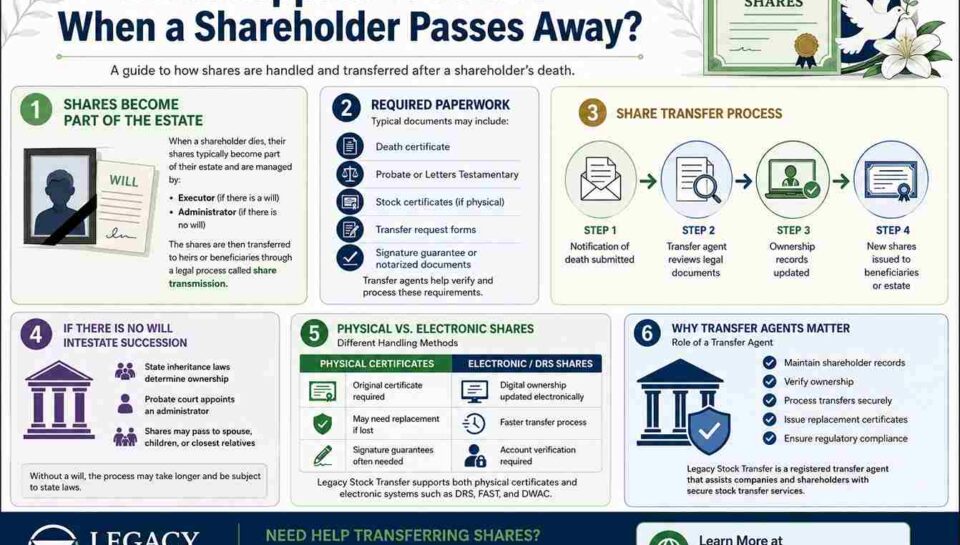
When a shareholder dies, their shares do not go away or become void. They’re given to beneficiaries according to the law and the deceased’s estate plan.
This process relies on how the shares were held and if there’s a will. The relevant inheritance laws are also taken into account. Transfer agents are important players in making this change possible.
Key Takeaways
- The shares go to the estate of the person who died. They’re handled according to the will, intestacy laws, or beneficiary designations.
- Shares with rights of survivorship automatically go to the surviving owner. This helps keep things out of probate.
- Transfer agents need formal papers, like death certificates, to move or re-register shares. This makes sure that the law is followed.
What Happens to Stocks After the Shareholder’s Death?
A legitimate will says who gets a shareholder’s assets when they die. If there is no will, the laws of intestacy will decide how to divide the property.
Share registration is important for the transfer process. Probate frequently happens with shares that are owned by one person. Ownership of joint shares with right of survivorship transfers to the surviving owner.
Shares held in a trust are distributed according to the terms of the trust agreement. But shares with a designated beneficiary go straight to the named beneficiary. Probate isn’t needed for this.
The Process of Probate and Shares
Shares that are only in the name of the deceased and don’t have a beneficiary go through probate. This is a legal process in which a court checks the will. An executor is chosen to make sure that the assets are divided up.
During probate:
- The executor identifies and values the shares.
- The shares may be re-registered in the name of the estate.
- After debts and taxes are settled, shares are transferred to beneficiaries. Sometimes they are sold, and the money is given away.
The length of the probate process depends on where the shareholder lives and how complex their estate is. Before the executor can sell or move shares, they need to have the court’s permission.
Tax Considerations
In many countries, the cost basis of shares that you inherit often goes up. The value of the shares is modified to what they would be valued on the day they die. When the beneficiary sells the shares later, they will have to pay capital gains tax. It is based on the higher worth, not the price at which it was first sold.
There could be other tax effects:
- The shareholder might have to pay taxes on their inherited stock. It all depends on the rules in that location.
- The estate has to pay taxes on the money it makes from selling shares.
- Beneficiaries have to report certain things.
Tax rules vary by country and sometimes by state or province. Getting professional help is often a smart idea.
How Transfer Agents Handle Shares After a Shareholder’s Death
When a shareholder dies, the transfer agent services do the following:
- Look at the death certificate.
- Read legal documents like affidavits, letters testamentary, or orders from probate court.
- Verify the identities of the beneficiaries or executors.
- Re-register the shares in the name of the estate or the new owner.
- Send out new share certificates or electronic confirmations.
Transfer agents like Legacy Stock Transfer have standardised procedures. They can handle deceased shareholder accounts.
Transfer agents don’t decide who gets something when the shareowner dies. They only act when they have the proper legal papers. Their job is to keep shareholder records up to date to show that ownership has changed legally.
Shares Owned in a Brokerage Account
A brokerage business handles moving shares from one brokerage account to another. These companies will need certain papers:
- A certified copy of the death certificate
- Proof of the appointment of an executor or the naming of a beneficiary
- Forms for the transfer have been filled out
If there is a specified beneficiary or joint owner on the account, the process goes faster.
Frequently Asked Questions
-
Do shares transfer to family members after death?
No. Shares transfer according to a will, beneficiary designation, or joint ownership terms. Laws about intestacy cover some transactions.
-
Can people sell their shares before the will is probated?
No. The executor must first get permission from the probate court.
-
What papers do agents need to move shares when someone dies?
Agents usually need a death certificate, court appointment papers, and transfer forms.
-
What happens if there is no will?
Shares are usually distributed according to intestacy laws, which determine legal heirs.
-
Are shares that are passed down taxed right away?
Tax laws differ from place to place. If you sell the shares later, you may have to pay capital gains tax.