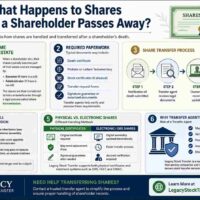



Physical stock certificates were the standard way to prove ownership of shares. These ornate paper documents symbolized real value for decades. That’s why shareholders tucked them away in safety deposit boxes. Sometimes they’re passed between investors as tangible proof of investment.
Nowadays, most companies have gone digital. They have shifted to electronic recordkeeping and dematerialized securities. This means many investors now own stock without ever touching a physical certificate.
Stock transfers without a certificate mean the shares exist in electronic form. Instead of a physical share certificate, ownership is recorded in a book-entry system. This is a digital record maintained by the company’s transfer agent. Or it could be under a central depository like the Depository Trust Company (DTC).
How Do I Transfer Stock Without a Certificate?
People transfer stock for personal, financial, or business reasons. Stock transfers are often the result of selling or trading shares. People can also transfer shares to family members as gifts or an inheritance. Mergers and stock splits could also involve share transfers.
Transferring stock without a certificate is becoming more common today. This is thanks to digital recordkeeping systems. A physical paper certificate is no longer used to prove ownership. Shares are now held in digital form. Companies do this via a process known as book-entry or uncertificated ownership.
Transferring stocks without a certificate is a straightforward process. Here’s how to go about it:
-
Determine How Your Shares Are Being Held
You should first identify where your shares are. The company might have it recorded through a transfer agent or a brokerage. The former means your shares are in your name on the company’s shareholder registry. Companies providing stock transfer agent services manage the registry. Or the shares are under a broker or custodian. They take part in a centralized system like the DTC.
You must know who holds your shares to determine who you need to contact to start the transfer.
-
Contact Your Transfer Agent or Broker
Reach out to the transfer agent if they’re the ones holding your shares. They will have specific instructions for you to follow. If it’s with a brokerage firm, you must get in touch with the broker. They can process the transfer electronically between accounts.
In both cases, you’ll need to provide identification. You should also know the person’s account or registration information.
-
Fill out a Stock Transfer Request Form
You will need to fill out a letter of instruction or a stock transfer form. This paper gives permission for shares to be moved from your account to another account.
Your name and account information must be on the transfer form or letter. It also needs the entire name and address of the person who will get it. You should also say how many shares you want to move and what class they are. Prepare any other relevant documentation, such as proof of ownership or trust papers.
-
Get a Medallion Signature Guarantee
Even without a certificate, most transfer agents need a Medallion Signature Guarantee. This is for security purposes. A Medallion Signature Guarantee is a stamp that you can get from a bank or financial institution. It verifies your identity and prevents unauthorized stock transfers.
-
Submit Supporting Documents
Depending on the type of transfer, you may need to include extra documents. The broker or transfer agent might ask for a death certificate for inherited shares. You might need a gift letter or court order for gifted or legal transfers. A corporate resolution is also needed if transferring business-owned shares.
-
The Transfer Agent Processes the Request
After verification, the transfer agent or broker will update ownership records electronically. No actual certificate changes hands. The company’s list of shareholders has been updated. It now shows information about the new shareholder.
Last Thoughts
Without a certificate, it could seem hard to move shares. But it’s not. This is the most frequent strategy in the digital financial world of today. Without a certificate, stock transfers are safe and quick. It’s designed to reduce the risks associated with paper certificates.
You must know how uncertificated stock transfers work. This is critical for smooth, compliant ownership transitions. You should also work with a company offering stock transfer agent services. They’ll ensure stock transfers are always handled with the highest level of accuracy.
Simplify Stock Transfers with Legacy
Make your life easier with Legacy Stock Transfer. We are a recognized transfer agent firm with the DTC. Our team of experts makes it easy to move stocks. We handle every uncertificated transfer according to the rules. Contact us here or at 972-612-4120 today. Let us streamline your shareholder management. You’ll soon experience the ease of modern, paperless share transfers.